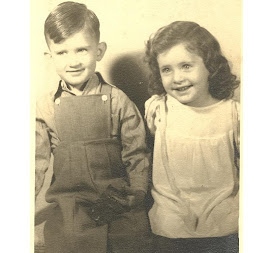
I have a picture of Dad on my wall. It shows him sitting at the kitchen table in his doublewide on the hill off Barr Road. He's reading the newspaper and wearing an orange mesh baseball cap. There are two things about the picture and the cap that are characteristic of Dad. First, the cap isn't down on his head fully; it's sitting almost on top of his head. The second is that the cap is at an angle, down over the right eye a little.
In almost all the pictures of Dad, and and in all my memories, I see that same thing. He tended to wear his caps and hats high on his head and at a slant. The slant gave him a slightly rakish appearance.
As a younger person, I wore my hat the way Dad did, over one eye. I don't any more, I'm not too sure why, but as I age, tend to wear my hats higher on my head, the way he did.
When Dad was working construction, he wore a heavy cotton work hat. It was a fedora, tan, with a reinforced brim. I thought then, and still think, that it was very cool. In fact, I'd like to be able to find an example of this hat and buy it for my own. They were very popular -- Paul Newman wore one in the movie "The Long Hot Summer."
I'd love to remember my Dad by wearing the same hat he did, but not slanted over the eye. I can't do that.
Tuesday, September 13, 2011

Tuesday, December 8, 2009
Dad and writing

Dad was a laconic writer, so the postcard was an excellent medium for him.
This postcard was mailed from Riverton, Wyoming, on May 30, 1949. Dad had gotten a job running a dragline on a job way out in the middle of nowhere, at a place called Muddy Creek. We lived the summer of 1949 in a M*A*S*H type tent way away from any form of civilization. We kids loved it.
The postcard reads, "Arrived Monday morning 11 AM, sure tired think Ill get a room and let Otto come find me. Seems like a right nice little place haven't seen much of it yet though will write tomorrow Love Jimmie"
Thursday, August 6, 2009
Dad
Dad was a skinny dude all his life. Photos that I have of him show a wiry individual. Yet he was an outdoorsman who frequently had to move large loads around. I remember going salmon fishing with him one fall when I was about 14. We went to Cook Inlet and set out some gill nets to catch the spawning salmon. They would swim into the nets, get caught, and we'd sit in a rowboat and haul them out. Dad would haul and haul, the net cutting into his hands, while everybody else took breaks, including me.
After we got the (many) fish home, Dad built a smokehouse for them, consisting of an oil drum stove and a wooden close with shelves in it for the fish. I burnt it down (by mistake).
Every fall, Dad and I would go moose hunting. A fully-grown moose weighs nearly a ton, so there was a lot of meat there, and that's how we got our year's supply of meat. Between that and smoked salmon, we ate gourmet food and I never knew it.
After we got the (many) fish home, Dad built a smokehouse for them, consisting of an oil drum stove and a wooden close with shelves in it for the fish. I burnt it down (by mistake).
Every fall, Dad and I would go moose hunting. A fully-grown moose weighs nearly a ton, so there was a lot of meat there, and that's how we got our year's supply of meat. Between that and smoked salmon, we ate gourmet food and I never knew it.
Tuesday, July 21, 2009
Travel
I remember spending a lot of my young life in the back seat of various automobiles, going to and from various places in the west. No freeways. In fact, most of our travel was on two-lane roads that followed the contour of the landscape. Mostly I remember our old 49 Hudson Commodore, black with gray fabric upholstery.
The landscapes tended to be bleak, desert or mountains, brown, tan, red, ocher -- any color but green. Occasionally, though, we'd pass fields of corn or alfalfa, and I'd watch the long rows march in long strides alongside our car. Sometimes, I'd put my hand out the window and observe what happened as I turned it in the airstream. Early lessons in aerodynamics.
Mom was our tour guide and entertainment center, as I don't recall ever listening to the radio. If we were passing a cemetery, she'd say, "A silent city," and make us be quiet until we'd passed it. If we were passing rugged terrain, say, in Arizona, she'd point to it and say, "Cochise's stronghold." Cochise, of course, was the legendary Apache chief. I remember thinking that Cochise sure had a lot of strongholds.
Two staples of travel back then were the billboards. There weren't many. The best of them were the Burmashave boards. They were small, maybe three feet by two feet, and came in a sequence. There would be five. The first four would give a little verse, and the last would say Burmashave. I liked those. You had to wait for each line of the verse to appear, but you always knew what the last one said.
There was another kind of billboard too. It would say something like, "Maguire Caverns 200 miles" in large letters. Underneath would be a list of the delights that could be found at the caverns, usually including a zoo. In another 50 miles, there'd be a "Maguire Caverns 150 miles" sign. By the time we finally reached Maguire Caverns, Tootie and I were frantic to stop, and had pestered Mom and Dad into stopping. Maguire Caverns, or whatever it was, was always somewhat of a disappointment. The "zoo" consisted usually of a mangy coyote and a lizard or two, and the "Caverns" would be a small cave with a store that hawked really really cheap souvenirs. I could usually wheedle Mom and Dad into buying a rubber knife or something else to torment Tootie with.
Oh, and we usually travelled about 55 mph the whole time.
Did I mention that the car was black, no air conditioning, and that it was invariably hot?
The landscapes tended to be bleak, desert or mountains, brown, tan, red, ocher -- any color but green. Occasionally, though, we'd pass fields of corn or alfalfa, and I'd watch the long rows march in long strides alongside our car. Sometimes, I'd put my hand out the window and observe what happened as I turned it in the airstream. Early lessons in aerodynamics.
Mom was our tour guide and entertainment center, as I don't recall ever listening to the radio. If we were passing a cemetery, she'd say, "A silent city," and make us be quiet until we'd passed it. If we were passing rugged terrain, say, in Arizona, she'd point to it and say, "Cochise's stronghold." Cochise, of course, was the legendary Apache chief. I remember thinking that Cochise sure had a lot of strongholds.
Two staples of travel back then were the billboards. There weren't many. The best of them were the Burmashave boards. They were small, maybe three feet by two feet, and came in a sequence. There would be five. The first four would give a little verse, and the last would say Burmashave. I liked those. You had to wait for each line of the verse to appear, but you always knew what the last one said.
There was another kind of billboard too. It would say something like, "Maguire Caverns 200 miles" in large letters. Underneath would be a list of the delights that could be found at the caverns, usually including a zoo. In another 50 miles, there'd be a "Maguire Caverns 150 miles" sign. By the time we finally reached Maguire Caverns, Tootie and I were frantic to stop, and had pestered Mom and Dad into stopping. Maguire Caverns, or whatever it was, was always somewhat of a disappointment. The "zoo" consisted usually of a mangy coyote and a lizard or two, and the "Caverns" would be a small cave with a store that hawked really really cheap souvenirs. I could usually wheedle Mom and Dad into buying a rubber knife or something else to torment Tootie with.
Oh, and we usually travelled about 55 mph the whole time.
Did I mention that the car was black, no air conditioning, and that it was invariably hot?
Tuesday, July 7, 2009
Boats
Since we are desert people, basically, so we haven't had all that much experience with boats. When we lived in Alaska, though, Mom and Dad got a homestead on the far end of a big lake, called, with some lack of creativity, Big Lake. The only way we could get there was by boat, so dad bought a home-made thing about 15 feet long and three feet wide, with an absolutely flat bottom. No keel, no skeg, no nothing. Whenever we took the boat across the lake, it had to be on a perfectly windless day. We'd start out and have a great old time skimming across the smooth water. Came time to turn, though, and things got exciting. Dad would turn the engine, and the boat would turn all right, but keep going in the same direction. So, we'd be motoring north with the body of the boat pointed northwest and making the same speed. In order to turn, we'd have to slow way down, carefully get the boat pointed in the right direction, and take off again. Dad knew what was wrong, but I don't know if he ever fixed the problem or just left it to the next owner.
Dad liked to build things strong. So, one day -- I was in college by this time and we lived near Lake Powell -- he found a build-your-own-boat ad in Popular Mechanics, I think it was and sent off for a set of plans. The boat was kind of wedge-shaped, not pointed at the prow, and was designed to run on two skis, or sponsons, at the front. It was to be built of light-weight plywood. Dad built the boat to specs, then decided that it wasn't strong enough, and covered the whole thing with fiberglass, making it about three times its original weight. He finished it off with a plastic windshield and two seats made of red Naugahyde bar stools with short backs and no legs on them. The whole thing was maybe two feet tall, and looked racy as all get out.
Unfortunately, it was also too heavy to be much of a boat. It was supposed to get up on the front skis and skim along the water. However, we never did, to my recollection, get it up out of the water. Finally, I think Dad just junked the whole thing and bought a nifty little Lone Star aluminum 16 footer that was one of my favorite boats.
Dad liked to build things strong. So, one day -- I was in college by this time and we lived near Lake Powell -- he found a build-your-own-boat ad in Popular Mechanics, I think it was and sent off for a set of plans. The boat was kind of wedge-shaped, not pointed at the prow, and was designed to run on two skis, or sponsons, at the front. It was to be built of light-weight plywood. Dad built the boat to specs, then decided that it wasn't strong enough, and covered the whole thing with fiberglass, making it about three times its original weight. He finished it off with a plastic windshield and two seats made of red Naugahyde bar stools with short backs and no legs on them. The whole thing was maybe two feet tall, and looked racy as all get out.
Unfortunately, it was also too heavy to be much of a boat. It was supposed to get up on the front skis and skim along the water. However, we never did, to my recollection, get it up out of the water. Finally, I think Dad just junked the whole thing and bought a nifty little Lone Star aluminum 16 footer that was one of my favorite boats.
Tuesday, January 27, 2009
Pictures from 1964
While going through a stack of letters that my grandmother Carrie Della Sanders Smith had saved, I came upon a Christmas card to her from her sister Alice LePage. The postmark on the card was obscured, but there was one date on the pictures that were stuffed inside. It was August, 1964.
The picture below shows our grandparents sitting in the back dooyard of their home with some other people standing by. I haven't a clue who they might be, except he pictures were stuffed in the envelope from Aunt Alice, so maybe they are some of her children.
I'll have to check, but I think that was the year before Grandpa died.
Keep scrolling. There are three pictures, but for some reason there's a great distance between 'em when I publish the post.

The picture below is one of the ones stuffed in the same envelope. On the back of this picture it says "Joe and Boyd (Hualipai Indian)" Joe is on the right and is our cousin Emory Joseph Smith, Jr. He goes by Joe, while his dad of the same name (bottom picture) went by Emory or Buck.

On the back of the picture below, it says, "Buck Smith on Shoshone in bottom of Long Canyon." That's Emory Joseph Smith, son of Nathan and Della Smith, our grandparents, pictured in the top picture.

The picture below shows our grandparents sitting in the back dooyard of their home with some other people standing by. I haven't a clue who they might be, except he pictures were stuffed in the envelope from Aunt Alice, so maybe they are some of her children.
I'll have to check, but I think that was the year before Grandpa died.
Keep scrolling. There are three pictures, but for some reason there's a great distance between 'em when I publish the post.

The picture below is one of the ones stuffed in the same envelope. On the back of this picture it says "Joe and Boyd (Hualipai Indian)" Joe is on the right and is our cousin Emory Joseph Smith, Jr. He goes by Joe, while his dad of the same name (bottom picture) went by Emory or Buck.

On the back of the picture below, it says, "Buck Smith on Shoshone in bottom of Long Canyon." That's Emory Joseph Smith, son of Nathan and Della Smith, our grandparents, pictured in the top picture.

Monday, January 26, 2009
Cheating
 If you look at the book cover, you will see the pictures of two people. The woman is Louise, the man is Curtis Hext Smith. They were married, and their story is a large part of our family history. the book, Counting the Cost, is a novel based on the story of Curtis and Louise. The author of the novel is Liz Adair, but that isn't her real name (Well, it is, but not her birth name). Liz Adair is Tootie Shook, the other half of the Ronnie and Tootie duo creating this blog.
The novel/history is a fascinating look into life in southern New Mexico in the 1930's, full of information about cowboying, small town life, and the intricacies of family interactions. My mom and dad are there too, along with my brother Wally, who died as a very young child.
I recommend the novel for two reasons. First, it's a very good read. Second, it brings to life what it was like to be living and loving on the edge of the desert during the depression. Parts are hilarious, and parts are simply heartbreaking.
Tuesday, September 2, 2008
Aunt Elizabeth's Clocks
Elizabeth Ashbaugh was Mother's older sister. They were very close both while they were growing up and after they were grown. Mom was the traveler of the two; Elizabeth stayed in Truth or Consequences pretty much her whole life. I don't know that she traveled much at all. So, Mom would breeze into town from Alaska, or Utah, or Afghanistan, and they would take up life much as before. I don't know whether Elizabeth envied Mom, thought Mom was flightly, or whether she thought much about it at all.
Aunt Elizabeth (Tootie is, of course, named after her, a story all its own) lived in a cinderblock house on the outskirts of town west of T or C. In fact, I don't know if she lived in T or C or not, since the hamlet of Williamsburg was just west of her property. She lived, almost literally on the edge of town, in an area where the streets were gravel and there were no sidewalks.
I loved Aunt Elizabeth's house. It was shaded by trees all around, and cool even in summer. One of the things I remember is Aunt Elizabeth's eclectic choices for clocks. Three in particular. One was a huuuuge (to a ten-year old) grandfather clock of some gleaming red wood. It had a long pendulum that swung back and forth with a measured and solemn "tock." The second was right next to it on the wall. It was a clock that advertised some beer or other, Jax or Lone Star. It featured a revolving drum painted in blue colors. When the clock was plugged in, a light behind the clock shown through and the drum rotated, looking (if you had imagination) like a waterfall.
My favorite though, was a mantle clock that chimed. It had a bong-bong-bong-bong melody for the quarter hour, a longer one for the half, a longer still for the three-quarter, and a full melody for the hour, plus striking the numbers. That way, you could be in another room and know that it was fifteen past whatever hour had recently struck.
I loved to sleep in Aunt Elizabeth's house, because I would wake in the night and listen for burglars, arsonists, or monsters. Then the clock would chime and I'd know that everything was all right, and I'd go back to sleep.
I loved that clock so much that I recently bought one, a clock made in about 1930 that is as close as I could find to the one that Aunt Elizabeth had. I wake up in the night to hear it chime and I am as comforted now as I was then.
Aunt Elizabeth (Tootie is, of course, named after her, a story all its own) lived in a cinderblock house on the outskirts of town west of T or C. In fact, I don't know if she lived in T or C or not, since the hamlet of Williamsburg was just west of her property. She lived, almost literally on the edge of town, in an area where the streets were gravel and there were no sidewalks.
I loved Aunt Elizabeth's house. It was shaded by trees all around, and cool even in summer. One of the things I remember is Aunt Elizabeth's eclectic choices for clocks. Three in particular. One was a huuuuge (to a ten-year old) grandfather clock of some gleaming red wood. It had a long pendulum that swung back and forth with a measured and solemn "tock." The second was right next to it on the wall. It was a clock that advertised some beer or other, Jax or Lone Star. It featured a revolving drum painted in blue colors. When the clock was plugged in, a light behind the clock shown through and the drum rotated, looking (if you had imagination) like a waterfall.
My favorite though, was a mantle clock that chimed. It had a bong-bong-bong-bong melody for the quarter hour, a longer one for the half, a longer still for the three-quarter, and a full melody for the hour, plus striking the numbers. That way, you could be in another room and know that it was fifteen past whatever hour had recently struck.
I loved to sleep in Aunt Elizabeth's house, because I would wake in the night and listen for burglars, arsonists, or monsters. Then the clock would chime and I'd know that everything was all right, and I'd go back to sleep.
I loved that clock so much that I recently bought one, a clock made in about 1930 that is as close as I could find to the one that Aunt Elizabeth had. I wake up in the night to hear it chime and I am as comforted now as I was then.
Tuesday, June 24, 2008
Dad's family

This is Dad's family. It seems very Grapes of Wrath to me.
 The second image is the writing on the back of the picture. I really have no idea who the writer is, except that she is standing in front of "Dord," which I think was a nickname for Dorothy. The only ones I remember are Grandmother Shook, Esther, and Ralph, who is at the extreme right of the picture.
Monday, June 23, 2008
Aunt Ruth and the outlaw
 During the latter part of the 19th century and early part of the 20th, you could go down to your local photographer with a picture and he'd make it into postcards. The picture above was a postcard, though it was never sent through the mail. Seated on the horse is my grandmother's aunt Ruth. This is my Dad's side of the family.
On the back of the postcard is written,"This is Ruth and that notorious outlaw Frank James - a young man she had been keeping company with. He is in Mo. [Missouri] now."
The scene (adobe house and windmill) suggest New Mexico, but dad was born in Glenelder, Kansas, and I think that's a more likely possibility.
If it is indeed Frank James, the time would have to be about 1870. That would fit with the chronology of the family.
Saturday, May 17, 2008
Dad's "singing"
Dad couldn't carry a tune in a wheelbarrow. And, he didn't sing much. He'd sing in church, all right, and if you were next to him, you kind of had to ignore what he was doing and concentrate on getting your own notes right. But there were two songs that I remember him singing to us as kids. One was called "The Preacher and the Bear," about a preacher who went hunting on Sunday and got into a lot of trouble because of it. I think that this song appealed to his sense of humor, which tended towards puns and word play a lot. The song that I remember, though, was "The Wabash Cannonball," an old railroading song. I have no idea why Dad liked this song. Maybe it was the rhythm, "Listen to the jingle, the rumble and the roar...."Whatever, I really liked it, and I never hear it but I think of Dad singing it to me.
Monday, May 12, 2008
Easter

In Hot Springs, there was only one nice lawn in our neighborhood. Aunt Elizabeth had a lawn, it was true, but I don't remember it as thick and green. I don't even think we had a lawn, unless you count tumbleweeds. The lawn in the picture belonged to an older man who lived at the bottom of our block. The street was on a slope, but the man had built up the soil around his house so his lawn was level. We used to hunt for four-leaf clovers on his lawn. It was green and thick, and I can't imagine the time, energy, and money he must have put into that lawn. In the picture, we've been easter-egg hunting. The boy in the center with the jacket, has a bucket of easter eggs. The little guy kneeling to his right, our left, is me. Immediately to his left is our friend JoAnn Henning. I am ashamed to admit that I can't pick out my own dear sister. In the background is a 1949 Pontiac, I think, so I was nine or ten when this was taken. Possibly it was in the summer just before we went to Alaska, which would have made it 1951.
Sunday, May 11, 2008
Mother Used to Recite "Lasca"
Click here to go to one of my other blogs to see a copy of the poem in mother's handwriting and read the entire poem.
Thursday, May 8, 2008
Isn't She Tute?

This is me. I'm pretty sure this is Grandma's house in Hot Springs (now Truth or Consequences) New Mexico. I think we must have left Vancouver, Washington and gone home to stay with them while Dad was in Puerto Rico. I remember the train ride. We had a roomette, and mother said I washed my hands in the little sink all the way from Washington to New Mexico. I imagine she was glad to have something to keep me occupied. My hair was naturally curly. I imagine I was about 2 1/2.
I'll have to see if I can find the naked pose of Ron trying to get over the fence. That was in Oklahoma. Do you have the picture, Ron?
Tuesday, May 6, 2008
A Summer at Ojo Caliente

One summer, probably between my first and second grade? Maybe the year before, Dad was working on a highway in northern New Mexico. He built a little house trailer and away we went to camp the entire summer. We stayed near a village named Ojo Caliente, though in my memory there are lots more trees than you see in these pictures. We were probably camped among scrub pine. I have an idea that the people in the picture with dad and the dump truck were relatives who came to visit. He has

the look of being one of Anna and Gus Yarbro's sons. Maybe the one that lived with Mom and Dad when we were in Altas, Oklahoma when I was still a baby and Ronnie was just beginning to walk.
The fellow standing behind Dad (who is seated) with his hands on his hips looks very like Gus. I think he's the same fellow with the cowboy hat in his hand in front of the dump truck. As a Yarbro, he would have worn a Stetson.

Ronnie is walking right in front of the wheel of the tanker truck. That was our water supply. There was no electricity to our trailer, though there may have been a light plant down at the camp center. They built a platform so there could be dancing on special occasions.
The fellow on the bulldozer is not Dad. I think he must have been running a shovel or a dragline, because his oiler, Joe Gray was there at Ojo with us. He loved dad. He was a Mexican and called Dad Jeemy. His wife, Romelia, made flour tortillas every morning, and I always tried to be there when she was cooking them.
Back to the bulldozer. I looked at that picture, and the name Blackie came to my mind. Do you remember him, Ron?
That was a magical summer. Full of adventure and freedom. One day a truck carrying lettuce and other veggies turned over, and we all OD'd on lettuce. Mom gave us a salt shaker full of sugar, and we'd sprinkle it on the leaves, roll them up, and eat them. I can still taste it!
I can still remember the harrowing ride on a lowboy trailer to another town where the fellows were supposed to play baseball. The whole little camp community piled on the trailer and off we went on a shortcut through the mountains. It was a gravel road with hairpin turns so sharp that the truck would have to back up and jockey around to get around them. By the time we finally arrived, the game was over.
The construction company that Dad worked for was owned by Royal Skousen. I still have a picture that his wife did for my mother, a very pretty picture done in pastels on fine grade sandpaper of a path through a woods.
Thursday, May 1, 2008
Picnic on the knik

Mother taught Sunday School most of the time we lived in Alaska--usually the class that Ronnie and I were in. She said it was because no one else would teach Ron. He had this infuriating habit of goofing off but ALWAYS having the right answer to the question that the teacher asked to show him that he was being inattentive.
Mother loved teaching kids, and she loved parties, so we'd get together as a Sunday School class and do fun things. This is a summer cookout at the Knik river. In my last posting (just before Ron's posting about Wally) there was a picture of Mom standing on the highway that leads to this bridge. Just across the bridge, the highway makes a 90 degree turn and runs along the base of the mountain. Pioneer Peak is its name.
At this time of year, the river is quite narrow, but in late August a lake that forms behind a glacier eats its way through the ice and the whole lake empties into the Knik and pours out to sea. The lake is called Lake George, and the phenomenon is called the Lake George Breakup. It's quite spectacular, because the river gets huge and blocks of ice float down it.
Did I spell Knik right?
Wally

This unfortunately marred picture is our older brother, Walter Eugene Shook. He died, so the family story goes, shortly before his first birthday, of pneumonia. Dad made his coffin, a family friend dug the grave, and Wally was buried the next day without being embalmed. Mom and Dad were too poor to afford a stone, so they dug Wally's grave at a 90 degree angle to the other graves in the Las Palomas graveyard. Mom and Dad had lost their first boy's grave (see an earlier post), and they didn't want to lose Wally's. Later, our aunt Elizabeth had a small bronze marker made for Wally. Wally's grave overlooks the Rio Grande.
Out behind the firehouse

This picture was taken one winter when we lived at the Bureau of Reclamation housing at Eklutna, Alaska. There was a fire station there, and Dad was the volunteer fire chief. One day he bulldozed a skating rink outside the fire station, then set up lights around it. In the evenings after school, we'd go down to the rink (just the kids mostly), use the fire hoses to water the rink, then put the hoses on racks to drain. By the time we had finished with the hoses, the water was ice and ready to skate on. In this particular picture, someone is sitting on the bank with me on one side and Tootie on the other. I think it's Dad, but can't be sure. I know he skated with us once or twice, but not too often as it was very cold.
Wednesday, April 30, 2008
Mother and Pioneer Peak
 This is mother standing on the highway that ran from Palmer to Anchorage, probably somewhere in the vicinity of The Butte. The road ran straight to the mountain, crossed the Kinik River , and then ran along the base of the mountain alongside the river. We lived about four or five miles (?) from the place where the highway crossed the Kinik. Every spring a snow slide would come down and block traffic for a day or two.
This is obviously in summer, and I have an idea it was the first or second year we lived in Alaska.
Saturday, April 26, 2008
My Dad, the Provider

Dad was always a hunter. When we lived in Wyoming he hunted for deer and cottontail rabbits to supplement our diet. He shot a bear, too, but the meat turned out to be too strong to eat.
When we moved to Alaska he would go out each fall and bring home a moose. He was a very patient man and would locate a trail that had evidence of moose usage, and then he would sit and wait for one to come along.

He always came home with one, which he would skin, and then he and mother would cut it up down in the basement. Ron and I would wrap the meat, and in the freezer it would go. Mother always called the roasts rum roasts, no matter what part of the moose they came off of.
Moose is wonderful meat. It's very similar to beef, which was very, very expensive when we lived in Alaska.
Dad went hunting for carabou one year, but we didn't care for that meat as well, and mom asked him not to go again.
These pictures were taken somewhere in the early 1950's. I don't know who the fellow is who is helping Dad skin the moose.
Subscribe to:
Posts (Atom)